
Foundry Labs / From the community
Evolutionary AI: Explore More Than One Way to Solve a Problem
In this article
Optimization often asks for the single best answer to a fixed problem. At Tokyo AI's evolutionary algorithms session, talks by Sebastian Risi and Nathanael Aubert-Kato suggested a different research question: what happens when useful behavior emerges from many interacting parts and the rules for adaptation are themselves explored?
Search over ways to learn
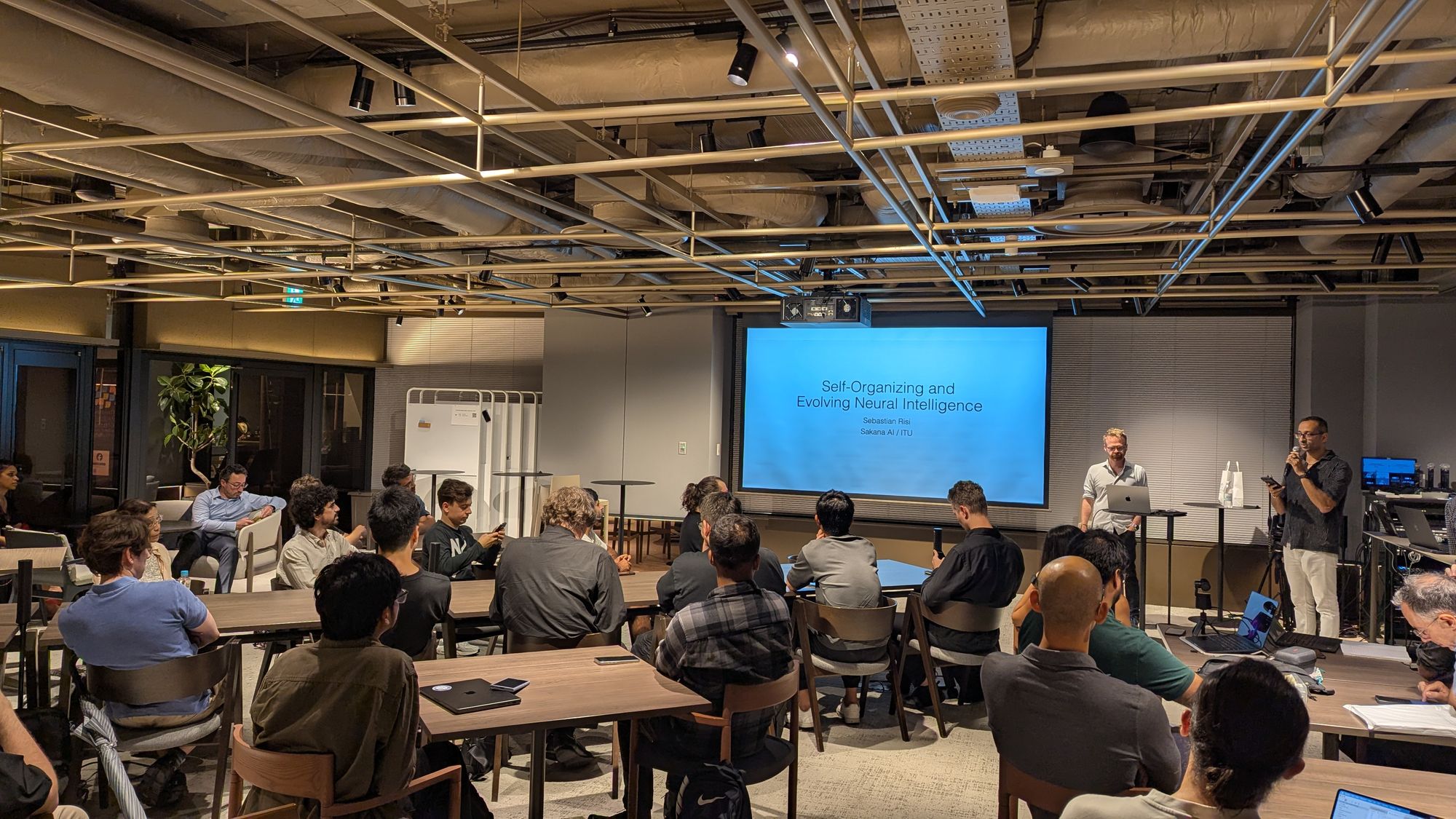
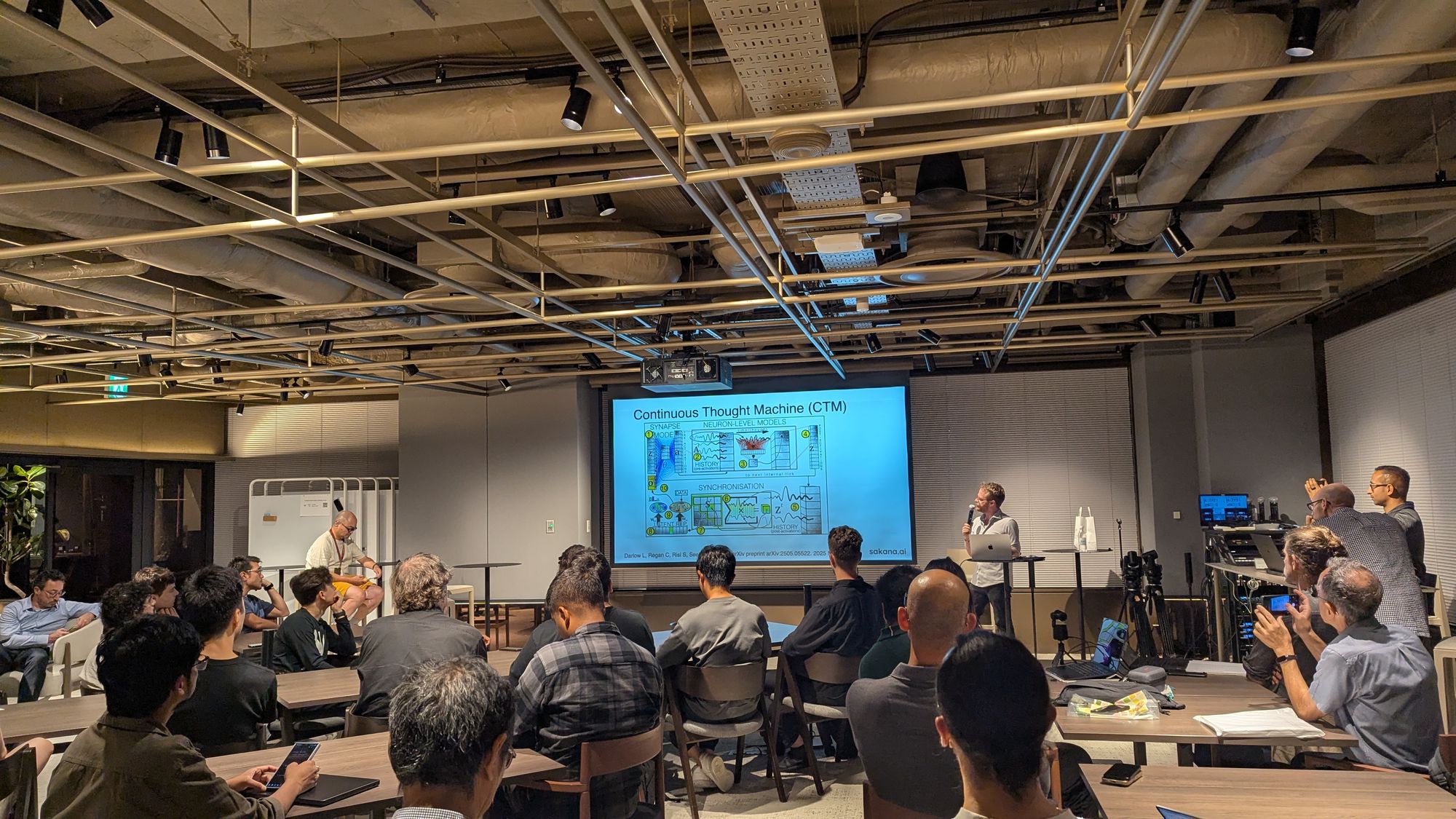
Sebastian's talk on self-organizing and evolving neural intelligence discussed evolving local learning rules. Instead of tuning every final weight directly, a researcher can search for a rule that lets a network adapt through interaction. The distinction matters because a system facing varied conditions may need the capacity to learn after deployment, not only a static configuration that scores well on one benchmark. That is a research direction, not evidence that such a method is ready for an enterprise process.
The evaluation must therefore ask more than whether a candidate solves a familiar test. Does it adapt to a changed environment? Does its behavior remain understandable enough to diagnose failure? Does the search exploit a loophole in the reward rather than produce the intended capability? Evolutionary search can find surprising solutions, and the researcher has to inspect what was actually selected.
Understand collective behavior
Nathanael Aubert-Kato's talk looked at swarms of molecular robots, where many limited entities interact to form larger structures. The programming problem differs sharply from controlling a conventional robot: local interactions and physical arrangement matter. It is an example of why an apparently simple rule can create complex system behavior, and why testing must consider the whole population rather than only one component.
For an applied team, the lesson is a design habit. When exploring multiple candidate workflows or controllers, preserve diversity long enough to see how they behave under different conditions; then test the chosen solution against the real operating boundary. An illustrative scheduling experiment, for example, should compare performance during normal and disrupted demand and inspect whether the candidate breaks a business rule. The event's research does not claim a proven scheduling product. It gives us better questions for evaluating adaptive systems.
Tokyo AI is a community of builders, researchers and business leaders in Japan, run by Foundry Labs. See the event page.
Materials from the speakers’ talks are available upon request. Please use our contact form and include the event title and speaker name.
Speakers
- Sebastian Risi, researcher in self-organizing and evolving neural intelligence.
- Nathanael Aubert-Kato, Associate Professor, Ochanomizu University.