
Foundry Labs / From the community
Deploying AI agents: responsibility, security and sovereignty
In this article
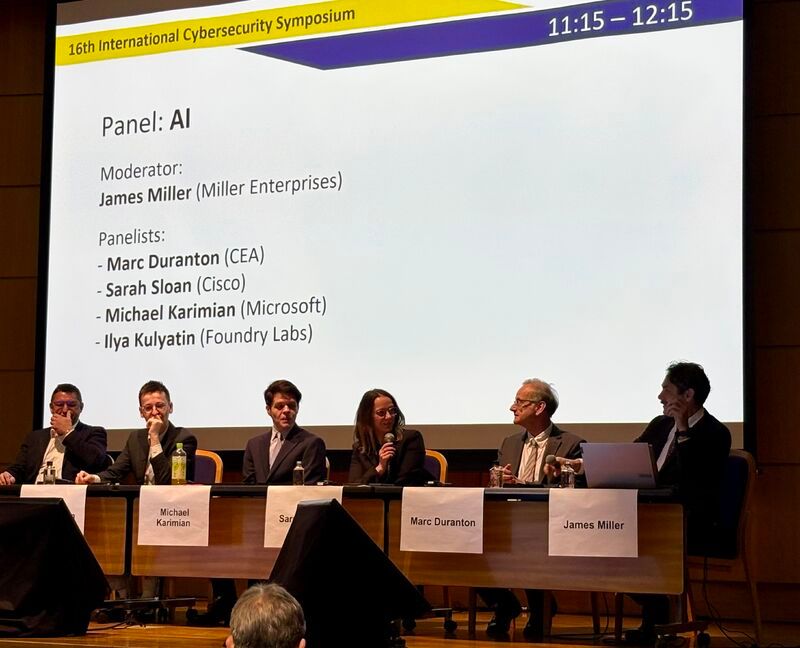
On 29 October 2026, I joined the panel on Trustworthy Autonomous AI at the 16th International Cybersecurity Symposium at Keio University in Tokyo. We discussed security, identity, control and sovereignty, all of which become very practical questions once an AI system can take action inside a business.
For a company deploying agents, the immediate decisions are fairly concrete. Which work should be automated? What information can the system access? Which decisions can it make, and who is responsible when something goes wrong? These decisions affect both the value of the system and the cost of operating it.
Understand the process before automating it
At Foundry, our work with Minarai starts with documenting the process: how work gets done, who is responsible, and whether it complies with the relevant requirements. Only then can we decide what needs to be automated and what can be automated reliably. If an approval rule is unclear or responsibility changes between departments, that needs to be resolved as part of the work.
Take invoice processing. Extracting information and matching an invoice to a purchase order are useful tasks to automate. Changing a supplier’s bank details requires a different level of control. The system needs to distinguish between those situations, apply the appropriate checks and involve someone with the authority to approve the change. The business benefit depends on how much work can be completed reliably and how much attention the exceptions still require.
Set permissions and plan for failures
This has direct consequences for the technical design. An agent should have access to the records and actions needed for its task, with limits enforced by the systems it uses. Identifying the agent is one part of that. Establishing whose authority it is acting under, and what that authority permits, is another. Those permissions should remain limited when work passes between agents.
Human review also has an operating cost. If every action needs approval, the team may spend its time supervising the automation. Reviews should concentrate on decisions that justify that attention, with enough context for the reviewer to make them. For a supplier change, that means seeing what changed, the supporting evidence and the checks already completed.
Testing needs to cover what happens when the workflow fails halfway through. Suppose an accounting system records a transaction but the agent never receives confirmation. A retry could create a duplicate. The system needs a way to check what happened before taking further action, and the team needs a way to correct the business record. Reverting the software would leave the duplicate in place.
Build the ability to retain control
The sovereignty discussion raises similar questions about control at a larger scale. Where does the data go? Who can administer the system? What happens if a provider changes its terms, withdraws a model or becomes unavailable? Running a model locally can address some dependencies, while leaving others in the hardware, software and maintenance arrangements.
For Japan, I would put the ability to build and operate these systems alongside investment in infrastructure. Companies need engineers who can evaluate a model, maintain the integrations, investigate failures and move to an alternative when necessary. Switching providers requires testing whether the replacement still meets the business requirements. That capability takes sustained investment in people as well as technology.
Put the controls to work
Sarah Sloan also raised the opportunity to use AI more effectively in cyber defence. There is useful work to do in investigating alerts, gathering evidence and proposing fixes. For a company deploying these systems, allowing an agent to investigate an issue is a different decision from allowing it to change a production system. The latter needs additional authorization, verification and a recovery procedure.
For companies considering agents, I would start with a process whose performance matters enough to improve. Document it with the people responsible, resolve gaps in the requirements and choose a useful part to automate. Measure the time saved, the errors and the work still required from the team. That gives management a basis for deciding where to expand.
Thank you to James Miller for moderating, and to Sarah Sloan, Eddy Almand, Michael Karimian and Marc Duranton for the discussion.
Ilya Kulyatin is CEO of Foundry Labs and founder of Tokyo AI. Foundry Labs builds custom AI systems with enterprise teams. To discuss an agent workflow in your organization, contact Foundry Labs.
All articles