
Foundry Labs / From the community
AI in IP enforcement: connecting detection to investigation
In this article
Foundry Labs co-founder and CTO Declan Clowry joined Bandai and Komehyo Holdings for a panel on AI and intellectual property enforcement at Europa House in Tokyo on 26 October 2026. The panel focused on cooperation between rights holders and enforcement agencies, and how detection tools can keep pace with changing methods of online counterfeiting.
The conference, “Combating IP Infringement in the Digital Age”, was organised by EUIPO under the EU-Japan IP Action project, in collaboration with the Japan Patent Office, and hosted by the EU Delegation to Japan. It brought together public authorities, platforms, industry and rights holders to examine the work between detecting a suspicious listing and taking enforcement action. EUIPO's conference report sets out the wider programme.
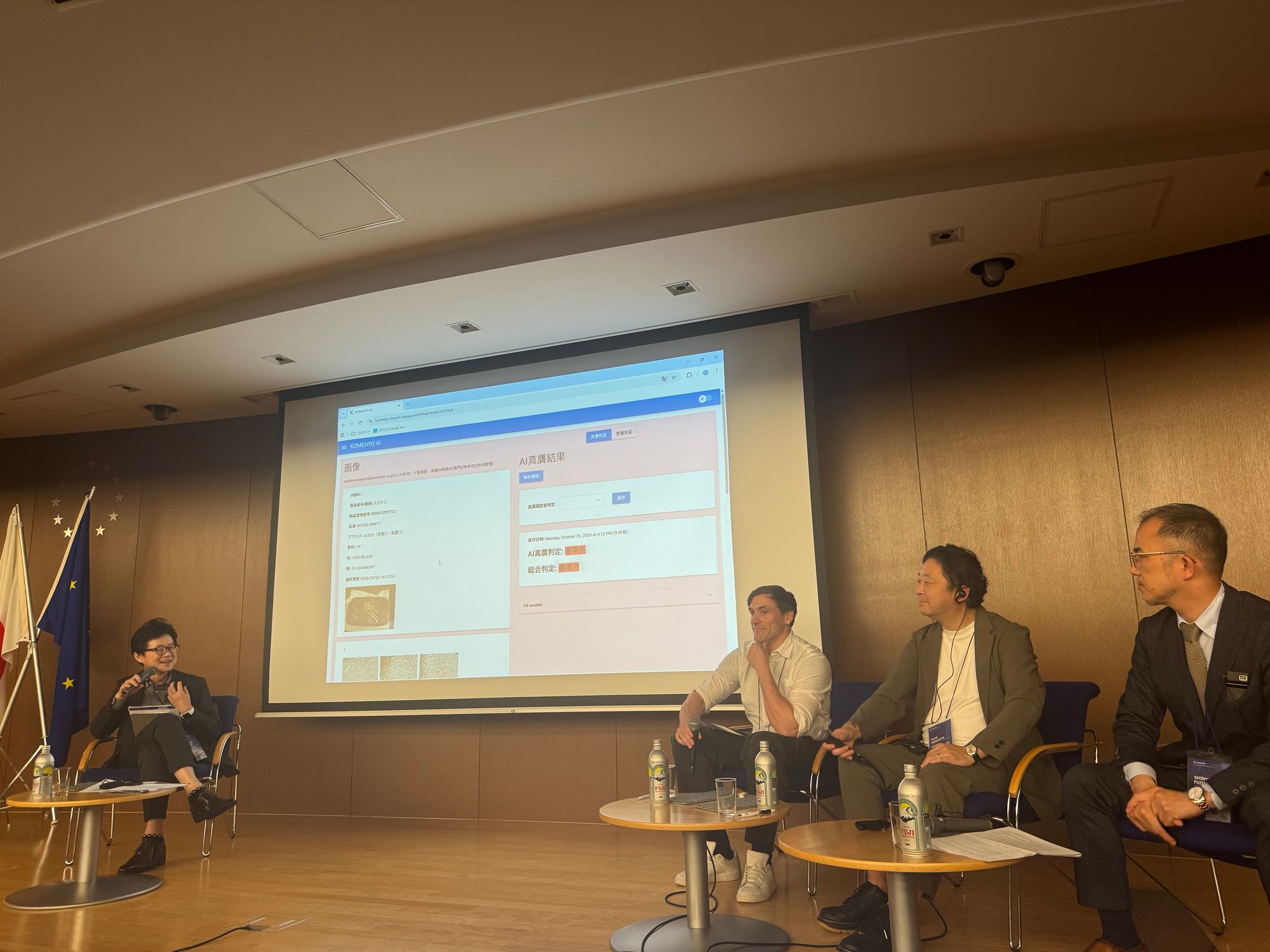
Bring product knowledge into detection
One of the questions put to the panel was how rights holders could help enforcement agencies improve the accuracy of their tools. The proposed areas of cooperation were concrete: product authentication data, examples of genuine and counterfeit goods, training, and feedback on investigation outcomes.
For teams designing these systems, that raises a question about how knowledge moves between organisations. A brand may be able to explain why a particular packaging detail is suspicious. An investigator needs that explanation alongside the listing or shipment being reviewed. A useful design would keep the supporting reference, the reason for the alert and the eventual decision together, so a later reviewer can understand the case.
That feedback also matters when an alert turns out to be wrong. Recording the reason gives the team something specific to correct, whether in the reference data, the detection model or the review procedure.
Account for changing sellers and content
The second panel question concerned evolving threats, including AI-generated listings, changing seller identities and activity across platforms.
These challenges make continuity an important design consideration. If a seller changes an account name or rewrites a listing, an investigation may still need earlier records and the evidence connecting them. A proposed system should preserve those links with their sources and uncertainty. Similar images or descriptions can be useful leads, but a reviewer still needs to establish what the connection means.
For a brand-protection team, this suggests evaluating more than individual alerts. It is also worth asking whether the tool helps investigators follow a case over time and explain why separate records deserve to be considered together.
A customs example from the same session
The session also included a presentation by Nacho Gomis of Spain's State Tax Administration Agency, AEAT, on AI-assisted maritime container inspection. CUSTOMAI's account describes combining customs declaration data, X-ray image recognition and vapour-detection sensors. Its Valencia port pilot aims to improve inspection targeting and reduce false-positive alerts.
This is a different setting from online listings, but it brings the same operational question into view: how should several sources of information help a team decide what to inspect? The project's stated aims concern both detection and the workload created by alerts. They should be read as project objectives, rather than measured results from this conference.
A practical starting point for deployment
From Foundry Labs' perspective, a useful pilot would begin with a defined review task and the people responsible for it. Consider a brand investigating suspected counterfeits in one product category. An initial system could assemble a case with the listing, relevant product references, previous observations and the reason it was flagged. A reviewer would record a decision and the evidence behind it.
The pilot could then assess review time, unnecessary alerts, missed cases found through separate checks, and how often the evidence was sufficient to act. Cases with missing or conflicting information would remain visible for follow-up. Those findings would give the team a basis for deciding whether to expand the system to more products or platforms.
Thank you to Marianna Kondas and the EU-Japan IP Action team for inviting Foundry Labs to contribute.
Foundry Labs builds custom AI systems with enterprise teams and is rooted in the Tokyo AI community. To discuss an AI-assisted investigation or review workflow, contact Foundry Labs.
About Declan Clowry
Declan is co-founder and CTO of Foundry Labs. He spent six years at Palantir, leading deployment teams in the UK, Germany and Japan, with experience across healthcare, defence and manufacturing. LinkedIn.
All articles