
Foundry Labs / From the community
AI for Scientific Discovery: Connect Predictions to Experiments
In this article
A model can propose a promising molecule or predict a reaction without completing a scientific discovery. The proposal still needs an experiment, a reliable measurement, and an interpretation that can change what the team tries next. The opportunity is in connecting those steps.
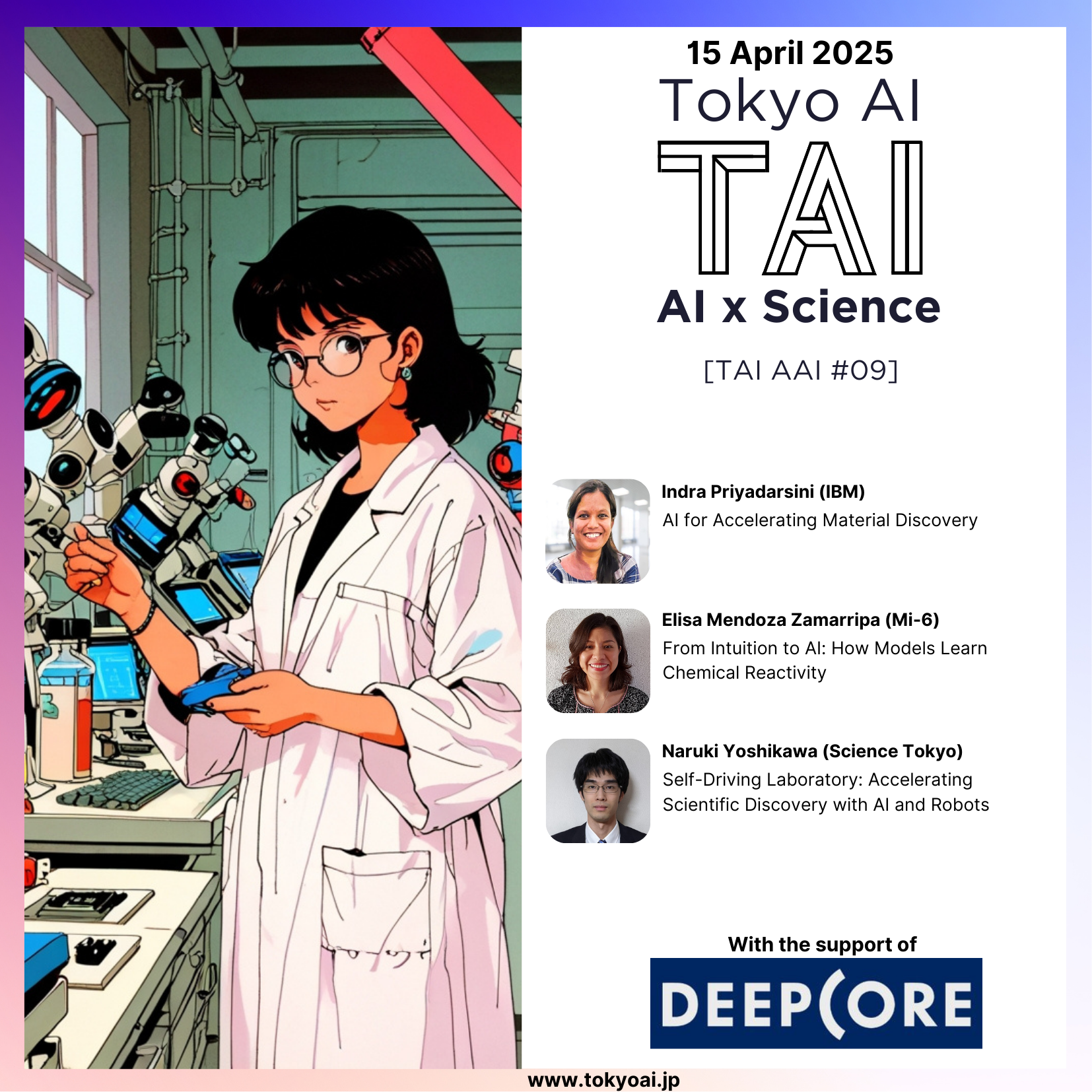
Tokyo AI’s AI x Science, held on 15 April 2025, brought together materials foundation models, chemical-reactivity prediction, and self-driving laboratories. The talks make a useful distinction between learning patterns in scientific data and building a process that tests those patterns in the world.
Representation determines what a model can work with
Elisa Mendoza Zamarripa, Data Scientist at MI-6, explains how chemical structures can be represented as graphs or as character sequences. In a molecular graph, atoms and bonds become nodes and edges. In a string representation such as SMILES, a molecular structure is expressed through a defined notation.
These are different ways of making chemical information available to a learning system. A graph neural network updates representations through connected parts of a structure. A transformer can learn relationships within a molecular sequence. Neither representation removes the need to ask what the training data captures and what it leaves out.
The practical implication is that a prediction carries the limits of its inputs and learning task. A model trained to predict a product is not automatically a validated explanation of the entire reaction. Useful scientific AI should help a researcher examine those limits rather than conceal them behind a confident answer.
A self-driving laboratory closes an experimental loop
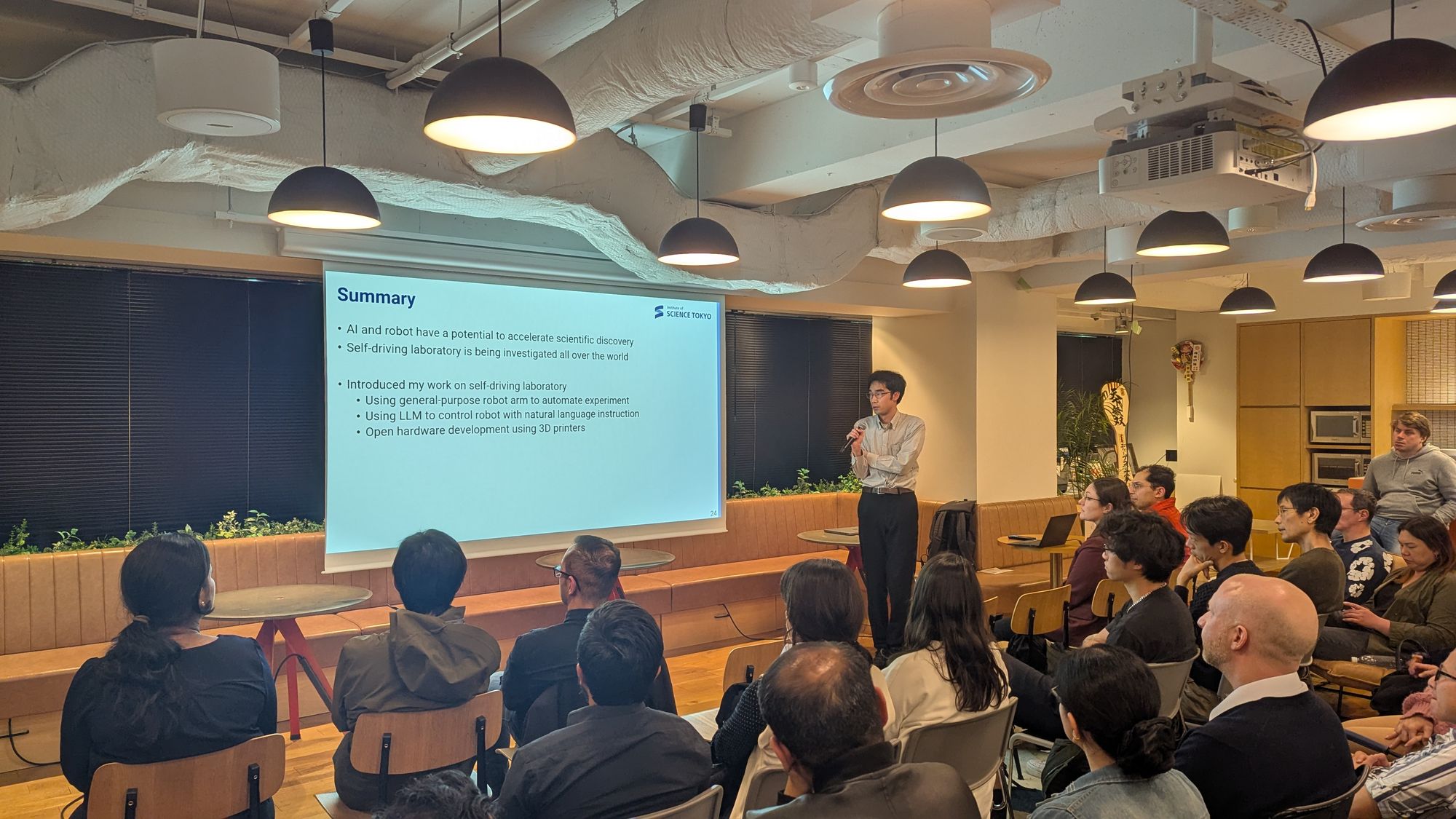
Naruki Yoshikawa, Assistant Professor at the Institute of Science Tokyo, describes self-driving laboratories as connecting automated experiments with data-driven decisions. His account of scientific discovery moves through existing knowledge, hypotheses, experiments, analysis, and new knowledge.
The valuable unit is therefore the loop, not the robot arm alone. A machine can repeat an experiment without helping choose a better next experiment. A model can suggest candidates without producing observations that test them. Combining the two requires a shared description of what was proposed, what was executed, and what was measured.
Indra Priyadarsini’s announced talk on foundation models for materials discovery adds the broader research direction: reusing learned representations for materials and chemistry. The deployment question remains how those capabilities enter a workflow where evidence can confirm or challenge a prediction.
Natural language needs an executable, checked interpretation
Yoshikawa’s work on natural-language interfaces illustrates this boundary. A researcher’s instruction is converted into a structured experimental language, XDL, and checked before being used for planning and robot control. His iterative method returns errors to the language model for revision.
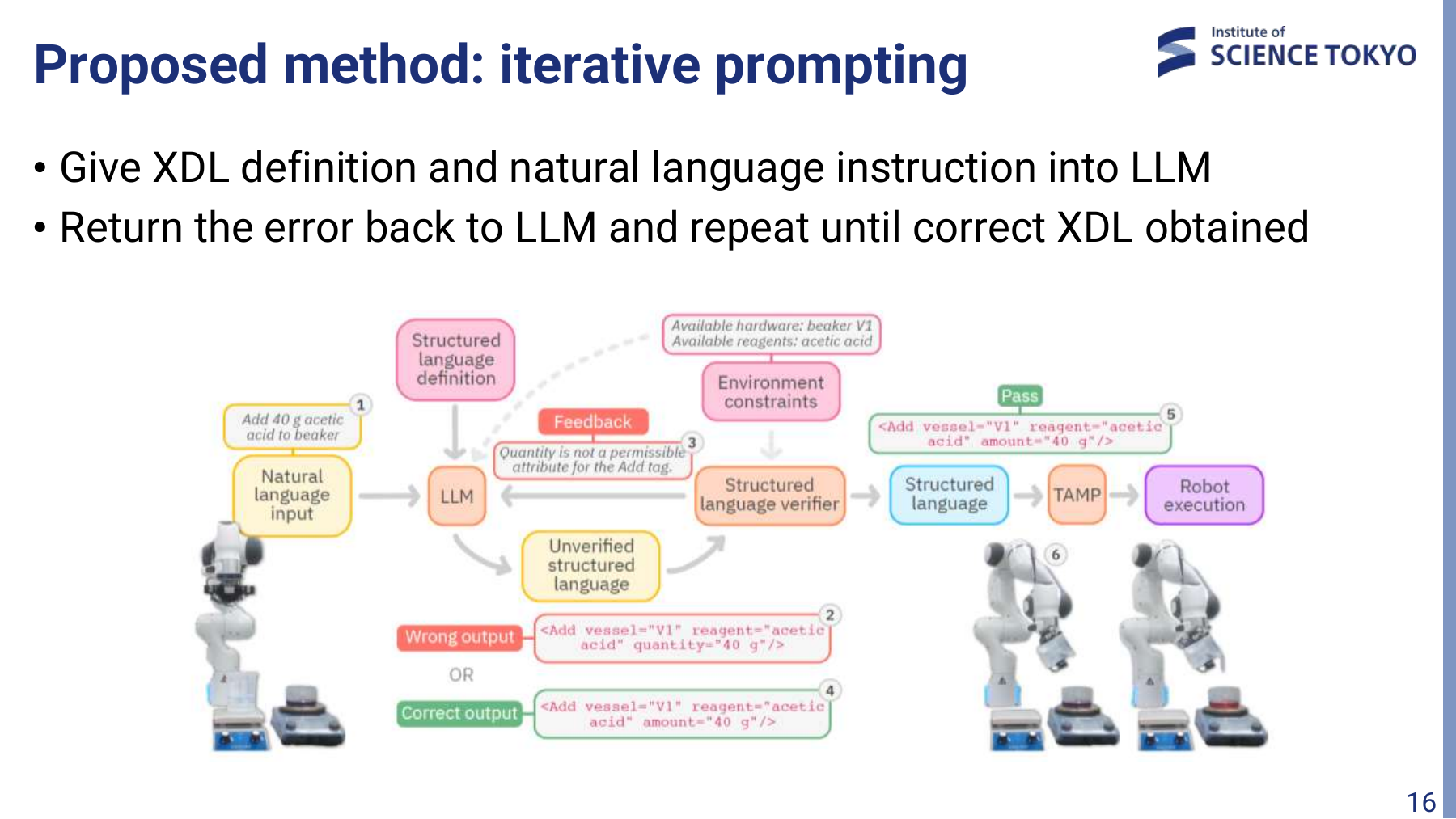
That feedback loop is more informative than assuming a fluent instruction is already executable. Natural language can leave details implicit. Hardware interfaces cannot. A structured representation provides somewhere to expose missing parameters, incompatible operations, or instructions outside the supported environment.
Passing a language or environment check is still not the same as establishing that an experiment is scientifically meaningful or safe. The scientific and equipment-specific review remains part of the broader process. The interface helps connect the researcher’s intent to the system’s actual capabilities.
Foundry’s perspective: preserve the chain from prediction to measurement
Consider an illustrative materials team using a model to prioritize candidates for a laboratory study. A PoC could rank a set of candidates from historical data. An operational workflow should preserve which dataset and model produced the ranking, which constraints the researcher applied, and why a candidate was selected for testing.
The next step is a handoff to an approved experimental process. The selected candidate, protocol version, equipment context, and resulting measurement need a stable relationship. If an experiment fails to run, that should not be recorded as though it were a valid negative scientific result.
We would design the data flow so researchers can distinguish a model error, an execution problem, and a measurement issue. That separation matters when the result returns to the learning loop. Otherwise, an equipment fault can become misleading training data and influence future recommendations.
An initial deployment could support candidate selection and record preparation while researchers retain experimental approval. Progress can be assessed through traceability, time spent preparing and reconciling records, and whether new observations can be reused confidently. Claims of faster discovery should follow evidence from the actual research process, rather than the speed of generating a candidate list.
This connects to Foundry Labs’ materials science and computational biology work: make predictions useful by designing the interfaces, data records, and validation steps through which they become testable scientific work.
Sources and further reading
This article draws on the TAI AAI #09 - AI x Science programme and the talks identified above. Tokyo AI (TAI) connects researchers, engineers, and industry; explore Foundry Labs’ community work for more context.
Talk materials from Elisa Mendoza Zamarripa and Naruki Yoshikawa are available upon request. Please use our contact form and include the event title and speaker name.
Speaker profiles
Indra Priyadarsini. Research Scientist at IBM Research Tokyo, working on AI for materials discovery. LinkedIn.
Elisa Mendoza Zamarripa. Data Scientist at MI-6, with a PhD background in biomedical science. LinkedIn.
Naruki Yoshikawa. Assistant Professor at the Institute of Science Tokyo, working on self-driving laboratories. LinkedIn.
All articles