
Foundry Labs / From the community
Physical AI Needs a Boundary Between Intent and Motion
In this article
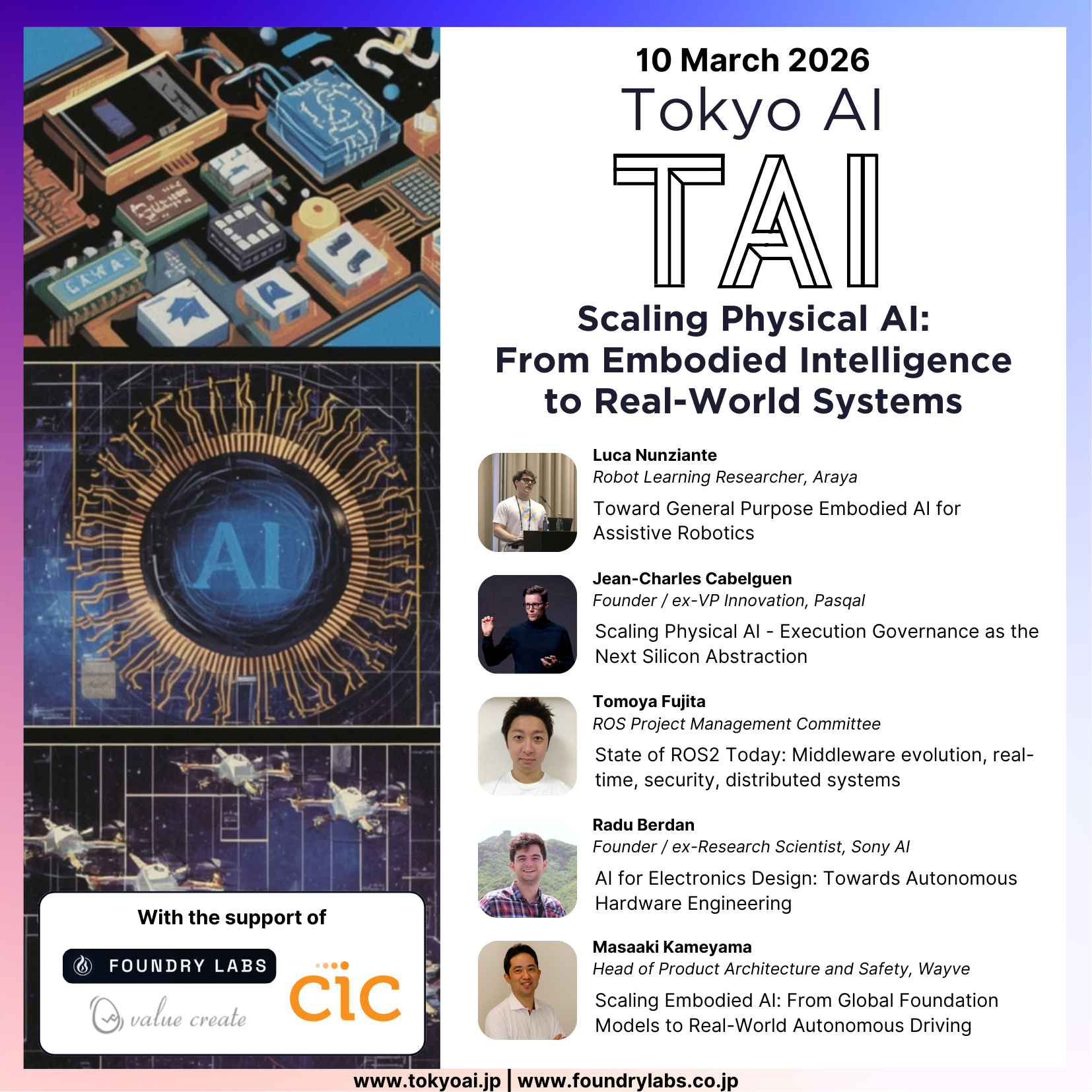
A robot’s plan is only the beginning of an action. The machine must execute that plan while its surroundings change, its hardware heats up, and a person may need to interrupt or redirect it. Physical AI therefore raises a system-design question: what governs the transition from intent to motion?
Tokyo AI’s Scaling Physical AI, held on 10 March 2026, explored this boundary through assistive robotics, execution governance, ROS 2, electronics design, and autonomous driving.
Separate a requested action from permission to execute it
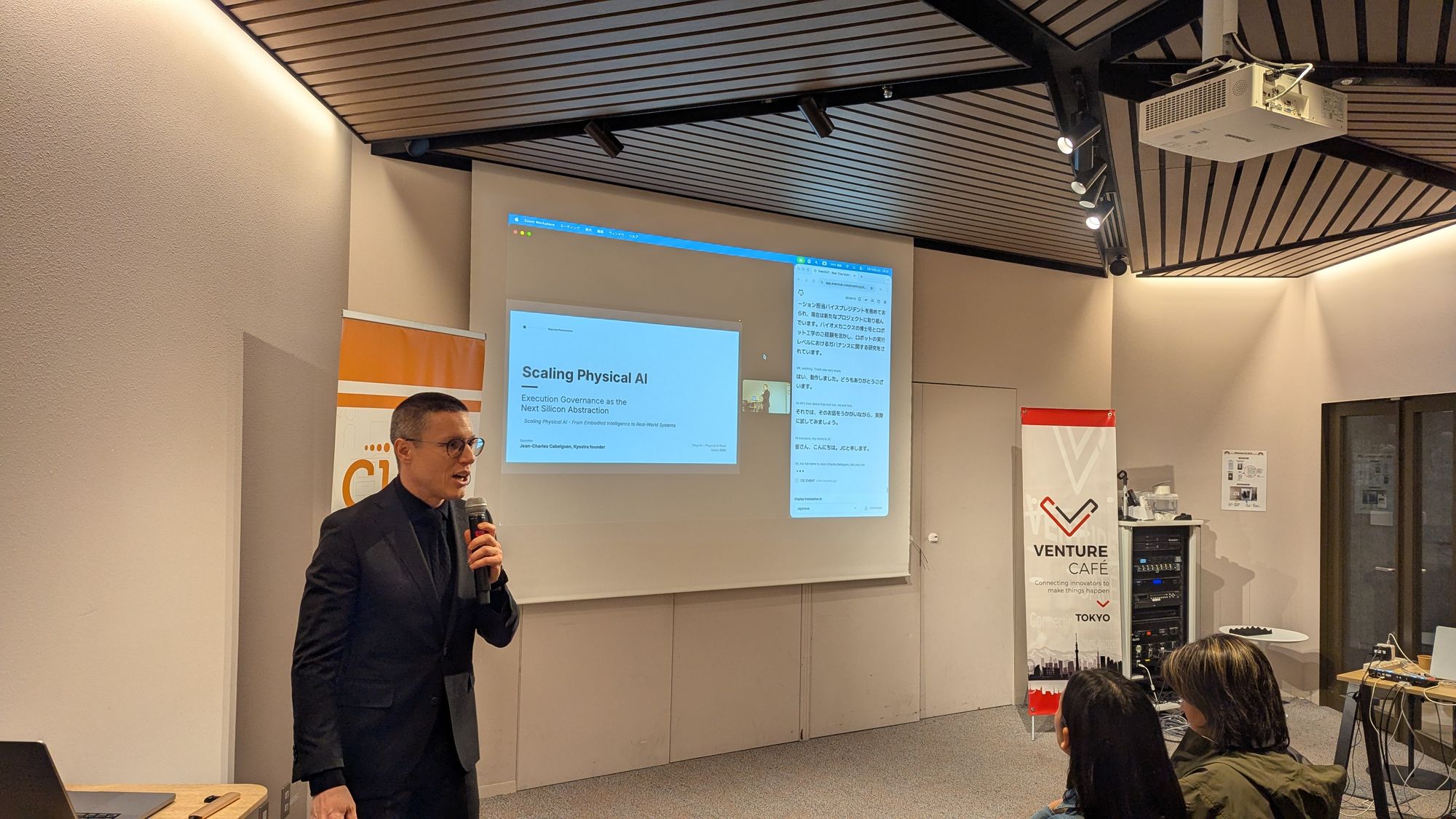
Jean-Charles Cabelguen, Founder of Kyostra, proposes an execution-governance layer between AI planning and physical actuation. Its role is to constrain how motion may occur, including authority limits, energy budgets, and safety bounds. It does not generate the motion itself.
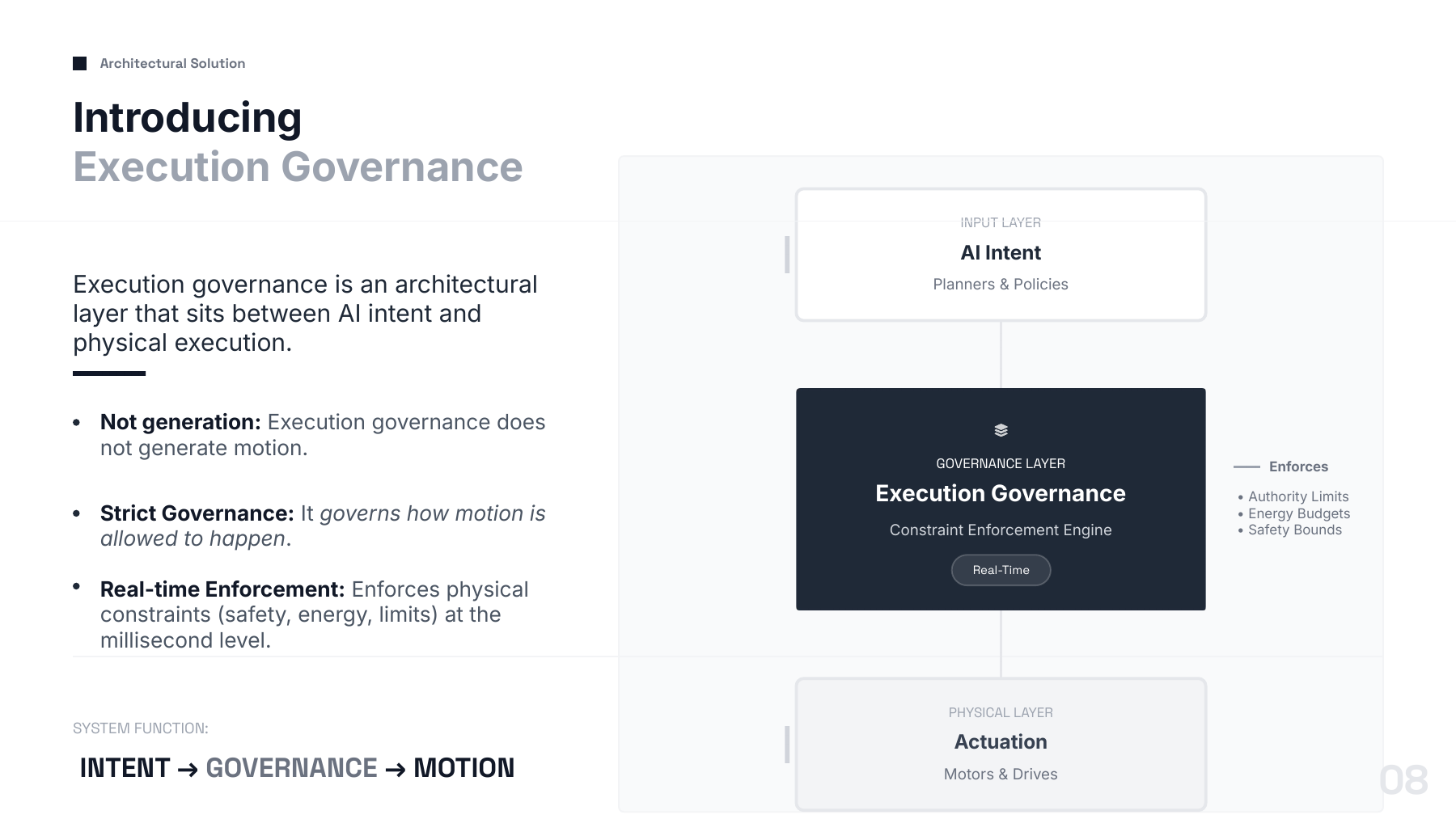
This distinction helps expose assumptions that might otherwise remain buried in an application. A planner can request a trajectory, but the request must be interpreted against the machine’s current state and permitted operating conditions. The same intended movement may have different consequences under a different load, with a blocked path, or after a hardware fault.
Cabelguen also distinguishes the timescales involved. Immediate control, ongoing coordination, energy management, and long-term wear are related but different problems. A system can perform a single action correctly while accumulating stress that makes repeated operation unreliable. The architecture is a proposal for making those constraints explicit, not evidence that a particular deployment has been certified safe.
Human intent is another uncertain input
Luca Nunziante, Robot Learning Researcher at Araya, connects generalist robot policies with intent decoding and user interaction in assistive robotics. His discussion includes different degrees of autonomy, from assisted teleoperation to shared autonomy and fuller automation.
That framing resists a simple assumption that more automation always improves an interaction. A person may want help executing a movement while retaining control over the goal. The system must make it possible to distinguish a mistaken interpretation from a deliberate instruction, and to change direction without a confusing struggle for control.
The engineering consequence is that the user interface and the control architecture need to be designed together. An interruption mechanism that exists technically but is hard to understand or use may not serve the person who depends on it.
The surrounding stack needs explicit interfaces
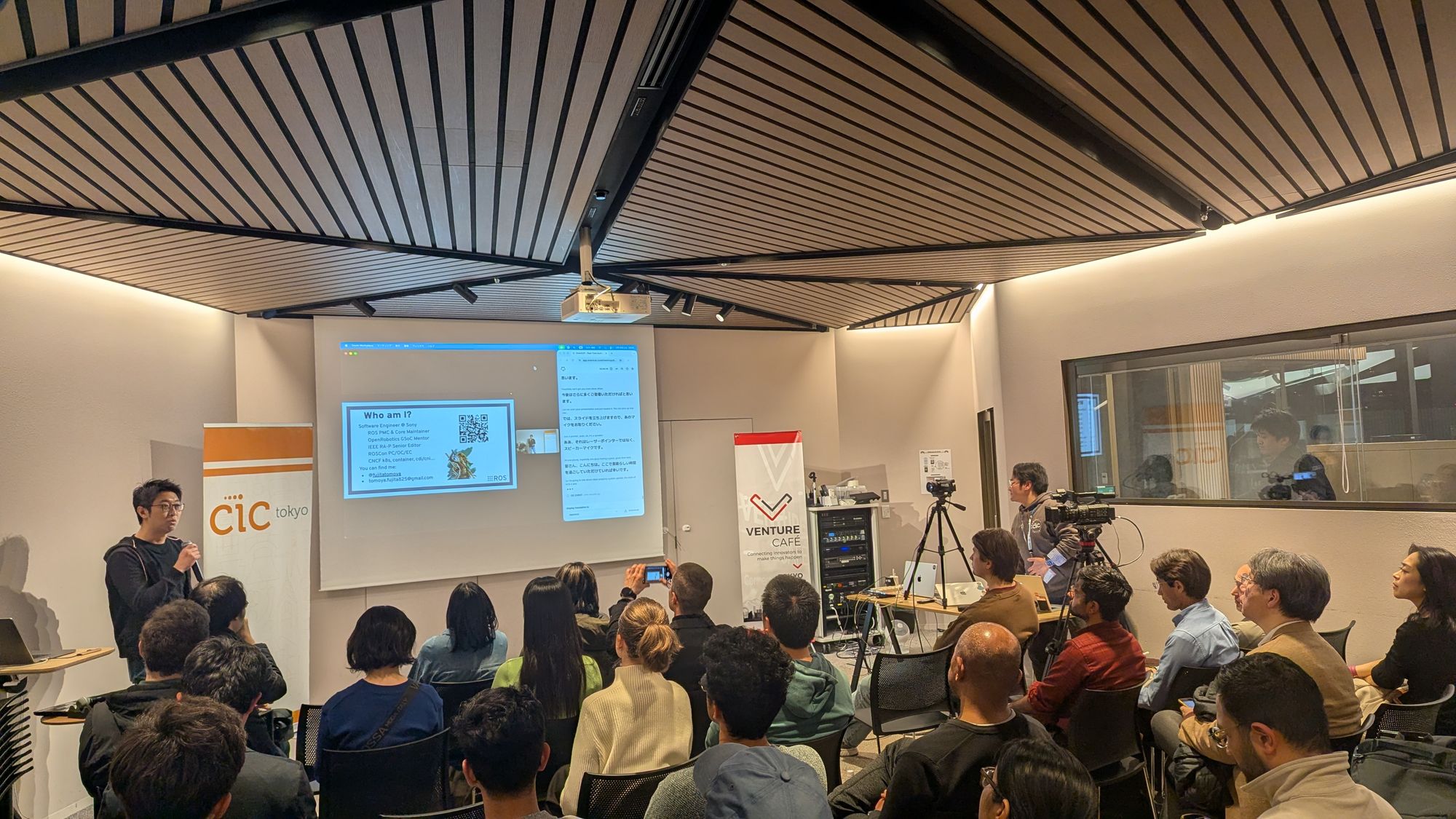
Tomoya Fujita’s ROS 2 update brings middleware and ecosystem maintenance into the conversation. A robot consists of communicating components, and the behavior of those interfaces matters alongside the learned policy. Release support, observability, and communication choices belong in the deployment plan.
Radu Berdan’s talk on electronics design adds another boundary. AI-assisted component selection, schematic generation, and review can help explore designs, but a convincing generated schematic is not equivalent to verified hardware. His discussion of review against component specifications points to the importance of checks grounded outside the model.
The programme’s autonomous-driving perspective, presented by Wayve’s Masaaki Kameyama, extends the question to architecture and validation across operating environments. Together, these topics place embodied intelligence inside a larger engineering lifecycle.
Foundry’s perspective: test the boundary, not only the successful motion
Consider an illustrative robot that moves parts between two workstations. A PoC can demonstrate successful transfers under a known arrangement. Moving into routine operation requires the team to define which conditions it is prepared to handle and what should happen outside them.
The system could separate task intent, motion planning, permission to execute, and low-level control. A change in the work area should lead to a defined response rather than an improvised continuation. Operators need to know whether the robot is waiting for clearance, recovering from a fault, or unable to complete the task.
Evaluation then includes interrupted transfers, changed object positions, lost sensor input, and restart behavior in a controlled test setting. The purpose is to establish how the system degrades and how responsibility returns to a person. Qualified robotics and safety specialists must determine the applicable limits and validation process for the actual installation.
Expansion should depend on evidence from the complete workflow: task completion, intervention demand, recovery, hardware condition, and the clarity of operator handoffs. A higher model success rate is valuable, but it does not answer every deployment question.
For Foundry Labs’ robotics and edge AI work, the relevant principle is to connect learned capability to explicit operating boundaries. Intelligence becomes usable when the rest of the system can govern its effects in the physical world.
Sources and further reading
This article draws on the Scaling Physical AI - From Embodied Intelligence to Real-World Systems programme and the talks identified above. Tokyo AI (TAI) connects researchers, engineers, and industry; explore Foundry Labs’ community work for more context.
Talk materials from Luca Nunziante, Jean-Charles Cabelguen, Tomoya Fujita, and Radu Berdan are available upon request. Please use our contact form and include the event title and speaker name.
Speaker profiles
Luca Nunziante. Robot Learning Researcher at Araya, working on embodied AI and assistive robotics. LinkedIn.
Jean-Charles Cabelguen. Founder of Kyostra. His talk proposes execution governance for physical AI. LinkedIn.
Tomoya Fujita. Software Engineer and Architect at Sony, and a ROS Project Management Committee member. LinkedIn.
Radu Berdan. Founder of Galvano AI. His talk examines AI-assisted electronics design. LinkedIn.
Masaaki Kameyama. Head of Product Architecture and Safety at Wayve, working on autonomous-driving systems. LinkedIn.
All articles