
Foundry Labs / From the community
Building Agent Workflows That Can Run Beyond the Demo
In this article
An agent that completes a demonstration has proved that one path can work. A production workflow must also make unfinished work, unexpected actions, and recovery understandable. The architectural question is how much freedom a task needs, and what the surrounding system must provide to make that freedom useful.
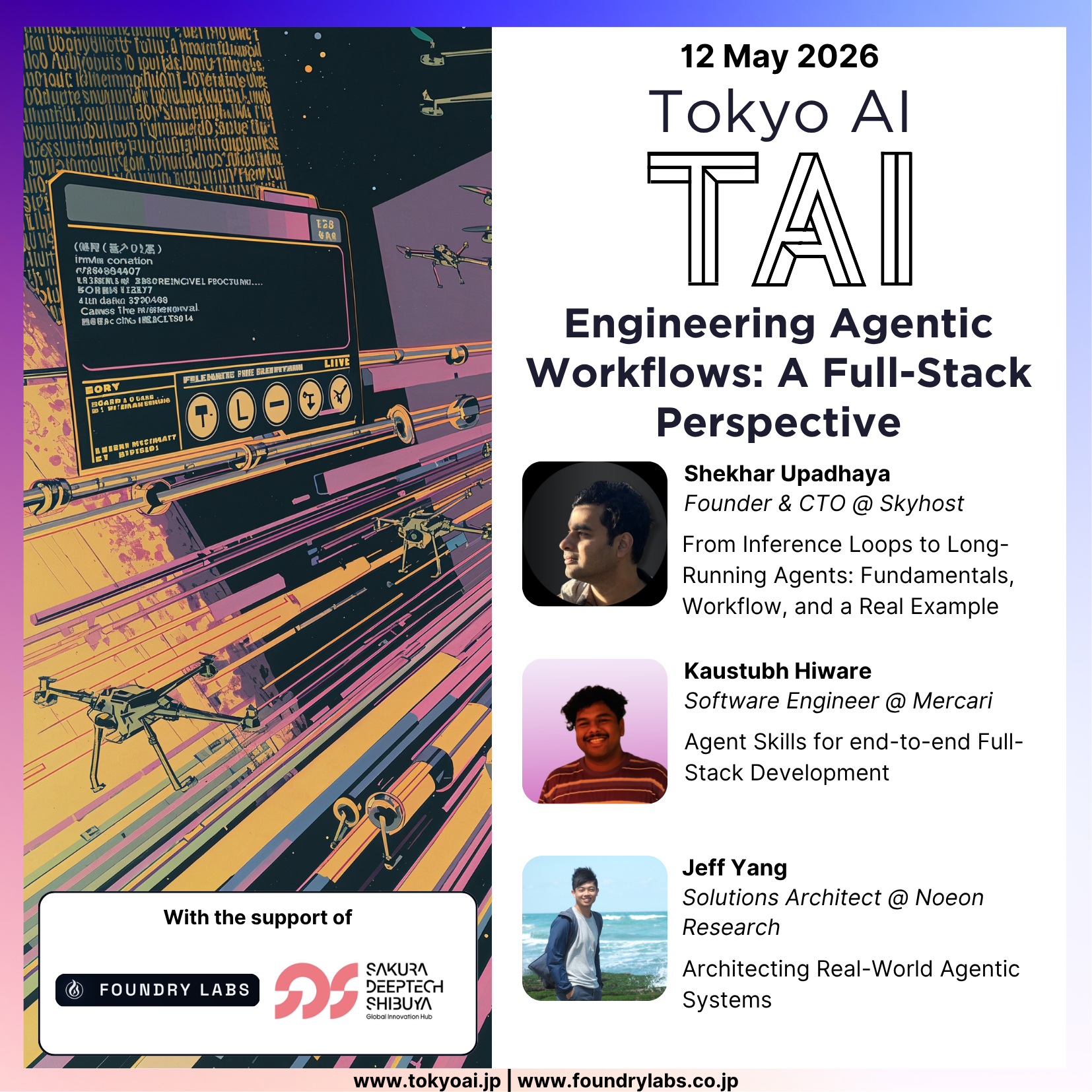
Tokyo AI’s Engineering Agentic Workflows: A Full-Stack Perspective, held on 12 May 2026, approached this question through long-running agents, reusable skills, and domain-specific system design.
Choose autonomy around the task
Jeff Yang, Lead Solution Architect at Noeon Research, presents workflows and agent harnesses as different choices about risk and control. They are not successive levels every organization must climb. If the steps are known and the acceptable outcomes are tightly specified, code can determine the sequence while a model handles a bounded interpretation task. An open-ended investigation may need the model to choose what to examine next.
This changes the first architecture conversation. Rather than asking whether a platform supports autonomous agents, ask which decisions genuinely require autonomy. A fixed document schema and explicit validation rules suggest one design. Diagnosing an unfamiliar software failure suggests another. The cost of an unexpected action belongs in the same discussion as the model’s reasoning ability.
Yang’s framework also asks whether the team can evaluate the complete task. A system whose final answer looks reasonable can still take an unacceptable route to reach it. Predictable failure, including a recognizable point at which work stops, is a production feature.
Skills make expertise reusable, but memory needs rules
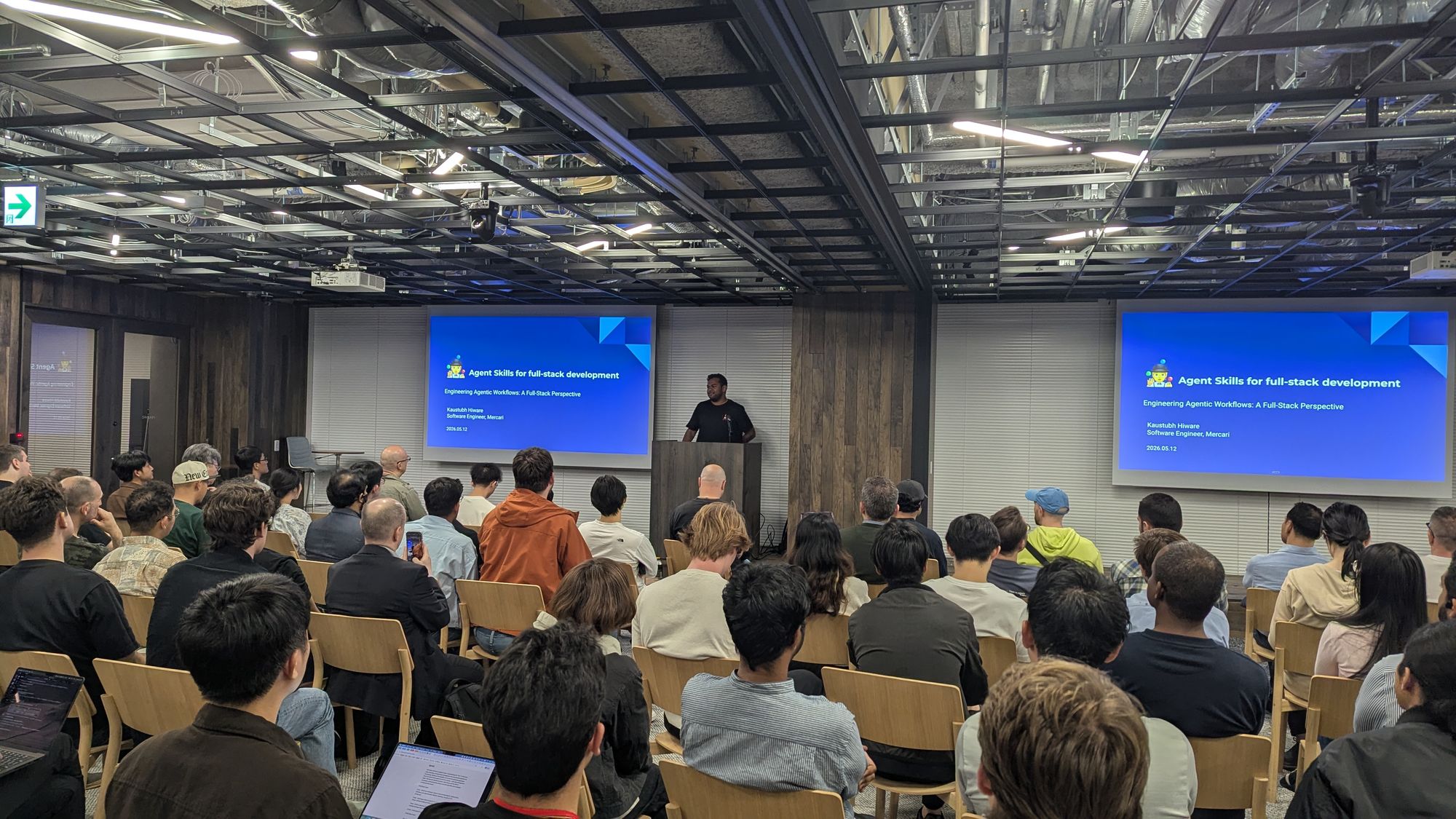
Kaustubh Hiware, Senior Software Engineer at Mercari, describes skills as structured packages of instructions, references, scripts, and reusable assets. His full-stack workflow connects design, planning, implementation, quality assurance, and demonstration. The useful idea is that domain knowledge can become an explicit part of how an agent works, instead of something repeatedly reconstructed in a prompt.
The distinction between kinds of memory is particularly practical. Hiware separates human-maintained knowledge, execution logs, and patterns learned from completed work. Those stores have different editing rules. A log records what happened; it should not silently become an authoritative operating procedure. A successful workaround may deserve a reusable pattern, but only after checking whether it overlaps with an existing one.
For an engineering team, that suggests a straightforward review question: who can change what the agent treats as truth? If a failed run can rewrite its own operating rules, the next run may inherit an error with the appearance of institutional knowledge.
Long-running work needs an observable environment
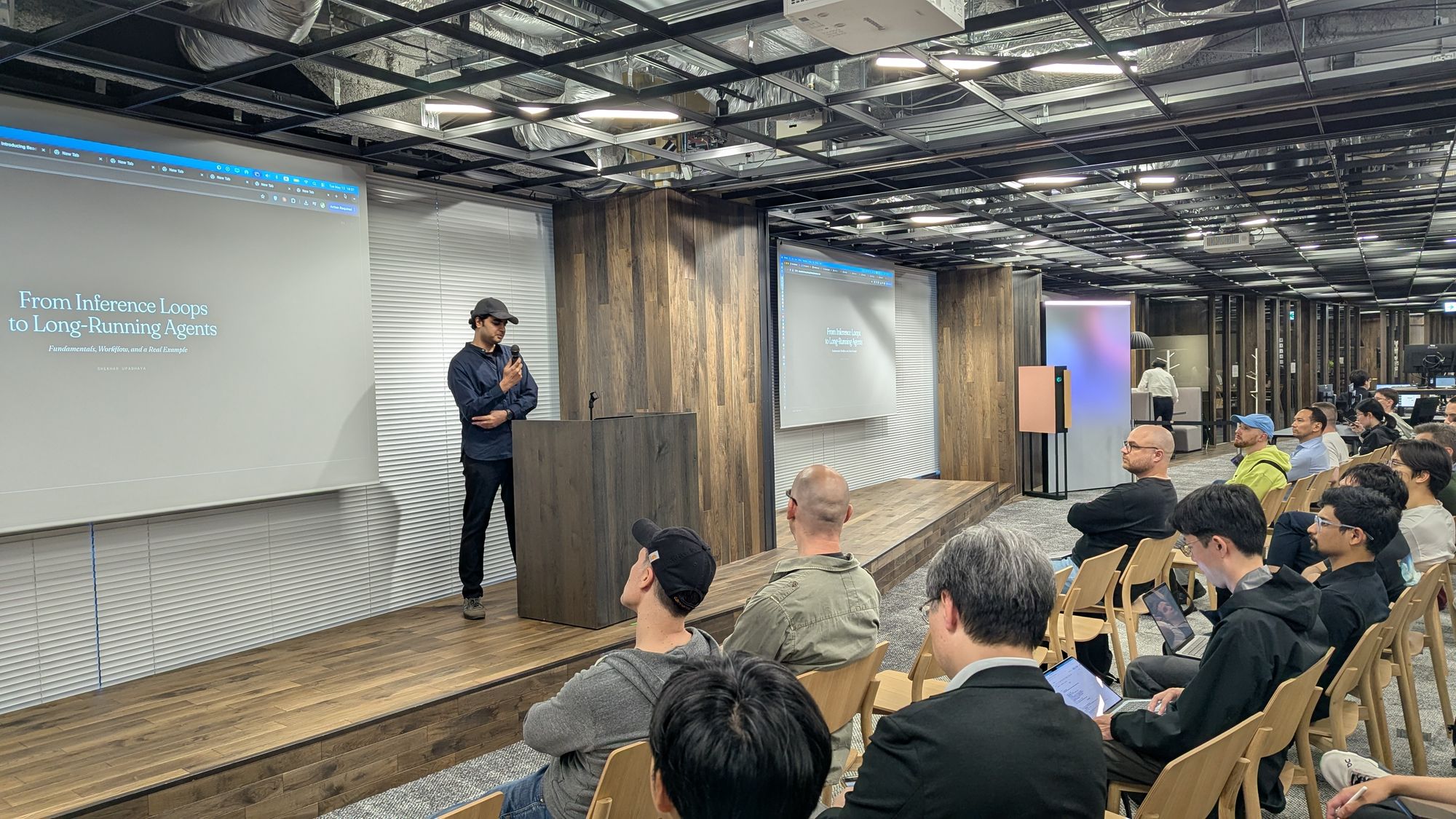
Shekhar Upadhaya’s talk, From Inference Loops to Long-Running Agents, centers on the model, tools, context window, and repository setup behind sustained agent work. The announced multi-file refactor example makes the operational challenge concrete: once a task spans many steps, keeping its purpose and state coherent becomes part of the engineering problem.
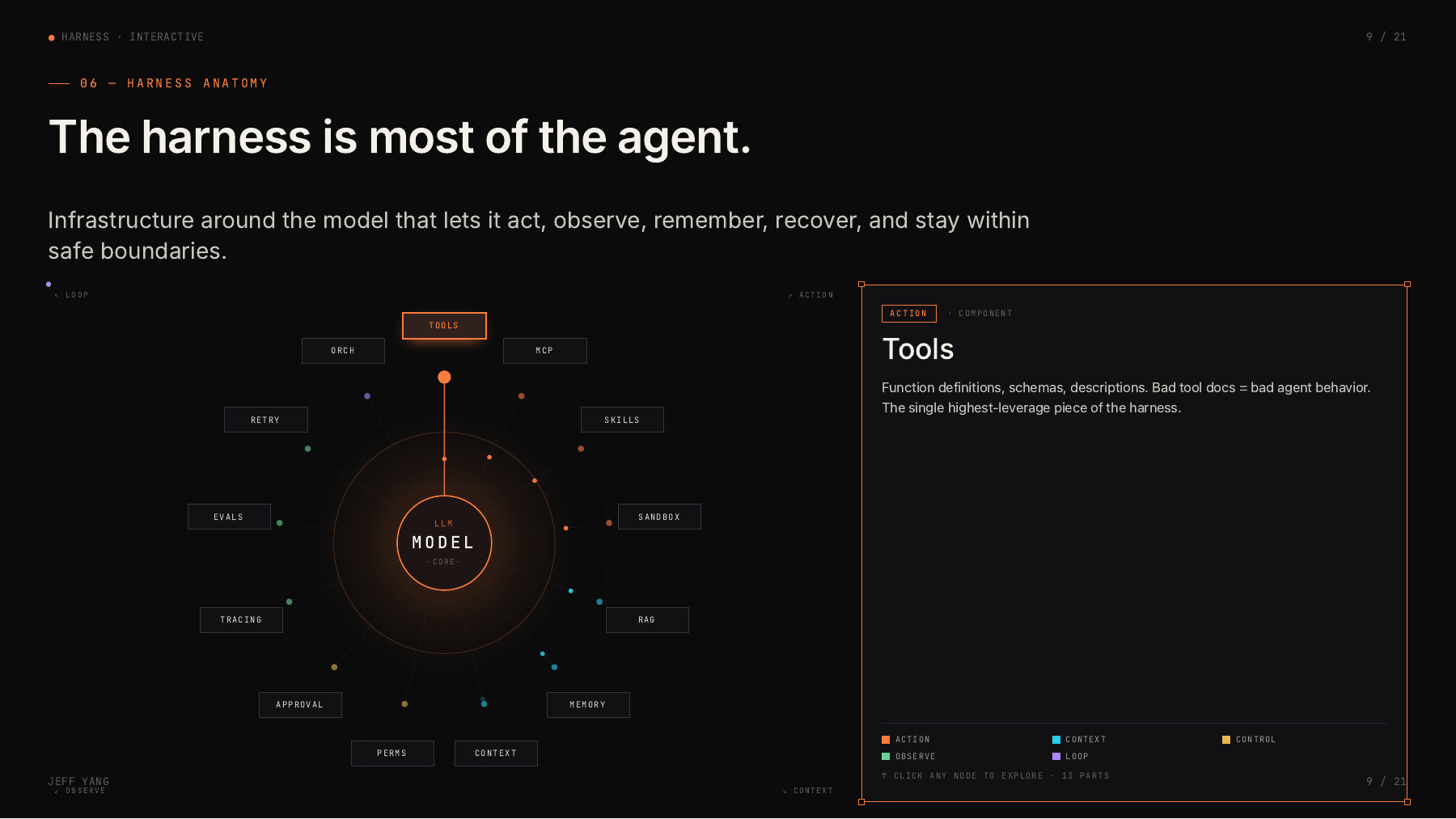
Yang’s harness diagram places tools, memory, permissions, approval, tracing, evaluation, and recovery around the model. These components determine what the agent can observe and how it can respond when something fails. They also create evidence for the person reviewing the result.
An error message that identifies the failed operation is more useful than a generic rejection. A validator that checks the intended output is more useful than asking the model whether it thinks it succeeded. Improving these interfaces can be a more direct intervention than replacing the model without understanding the failure.
Foundry’s perspective: make a refactor into reviewable work
Consider an illustrative project to migrate an internal service to a new API. A convincing PoC updates one endpoint. A usable deployment must preserve behavior across authentication, retries, error handling, and downstream callers.
We would begin by making the boundary of the change explicit: which modules may change, which interfaces must remain compatible, and which tests demonstrate that compatibility. The agent can investigate unfamiliar call sites and propose edits, while the surrounding workflow controls repository access, validation, and release approval. Autonomy is concentrated where exploration helps.
The work record should let another engineer resume the task without reading an entire conversation. It needs the completed changes, outstanding questions, failed checks, and the evidence behind each resolution. Reusable migration guidance belongs in reviewed reference material; the execution history remains a record of this particular run.
A pilot can then expand from one service to another based on accepted changes, reviewer effort, regressions, and recovery time. Measuring only generated code or elapsed agent time would miss much of the business cost. The outcome worth scaling is a change that the organization can understand, accept, and maintain. That is the connection to Foundry Labs’ enterprise AI engineering: model capability becomes useful through a workflow that can carry responsibility from implementation into operation.
Sources and further reading
This article draws on the Engineering Agentic Workflows - A Full-Stack Perspective programme and the talks identified above. Tokyo AI (TAI) connects researchers, engineers, and industry; explore Foundry Labs’ community work for more context.
Talk materials from Shekhar Upadhaya, Kaustubh Hiware, and Jeff Yang are available upon request. Please use our contact form and include the event title and speaker name.
Speaker profiles
Shekhar Upadhaya. Co-founder and CTO of Skyhost. His talk explores inference loops and long-running agents. LinkedIn.
Kaustubh Hiware. Senior Software Engineer at Mercari. His talk examines agent skills for full-stack development. LinkedIn.
Jeff Yang. Lead Solution Architect at Noeon Research. His work and talk focus on real-world agentic systems. LinkedIn.
All articles