
Foundry Labs / From the community
Vision-Language-Action Models: The Deployment Problem Is Time
In this article
A robot cannot pause the world while its model thinks. Objects move, people intervene, and the machine continues executing the action it already received. That makes inference time part of the behavior of a robotic system, not merely a measure of computing efficiency.
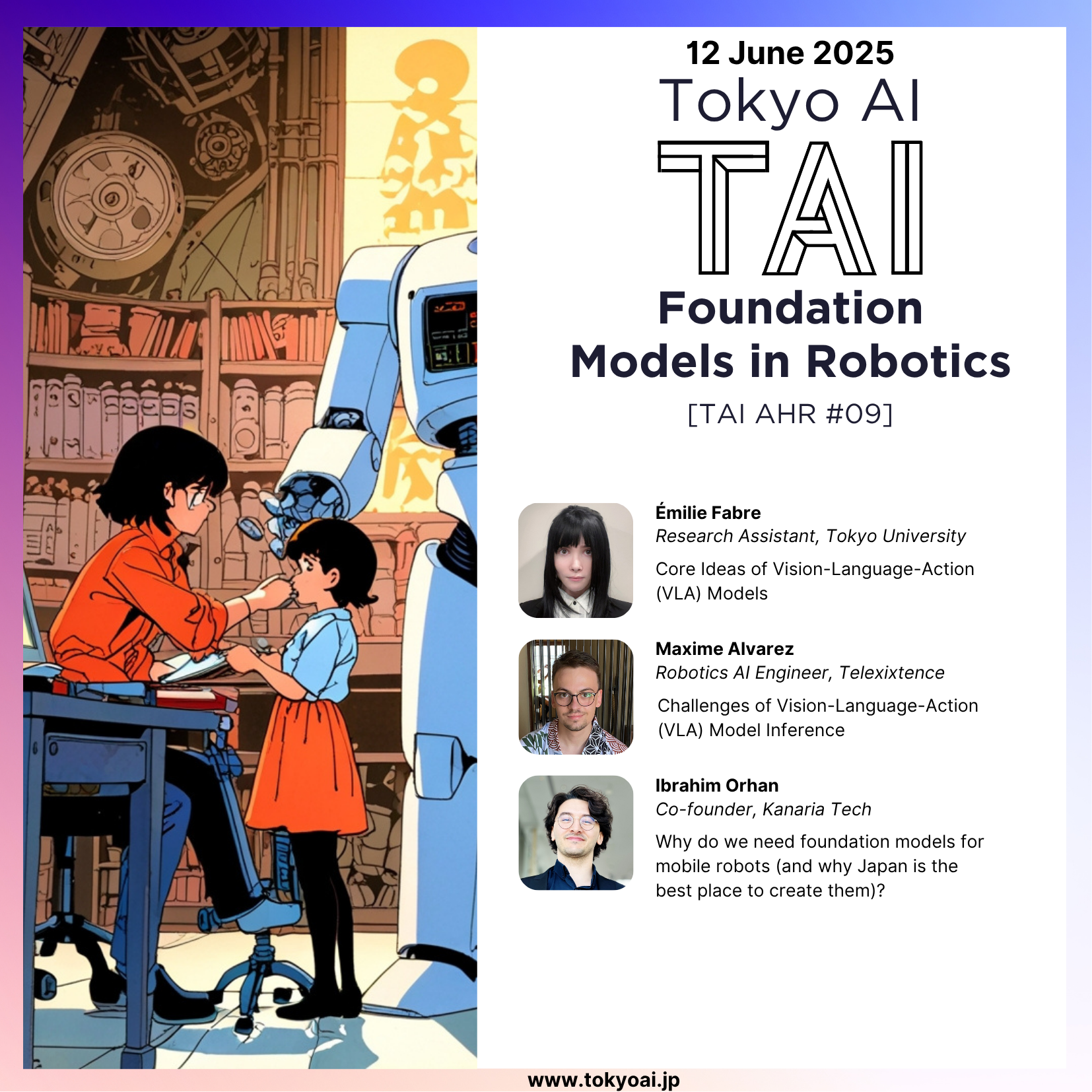
Tokyo AI’s Foundation Models for Robotics, held on 12 June 2025, explored vision-language-action models through their foundations, inference challenges, and the motivation for more capable mobile robots.
From seeing and describing to choosing an action
Émilie Fabre’s introduction to vision-language-action models, or VLAs, connects visual observations and language instructions with robot actions. The action representation matters: a command may concern joints or an end effector, and may specify an absolute position or a change from the current state.
Those distinctions can disappear in a natural-language demonstration. “Move the object” sounds simple to a person, but the deployed system needs an agreed representation of the motion and a connection to the actual machine. A model’s output is useful only if the rest of the system interprets it consistently.
Fabre’s discussion also places VLA models in the context of training data and generalization. Learning from demonstrations can support a wider range of tasks, but the deployment still needs evidence that the learned behavior applies to its objects, cameras, and robot configuration.
Inference and action compete for time
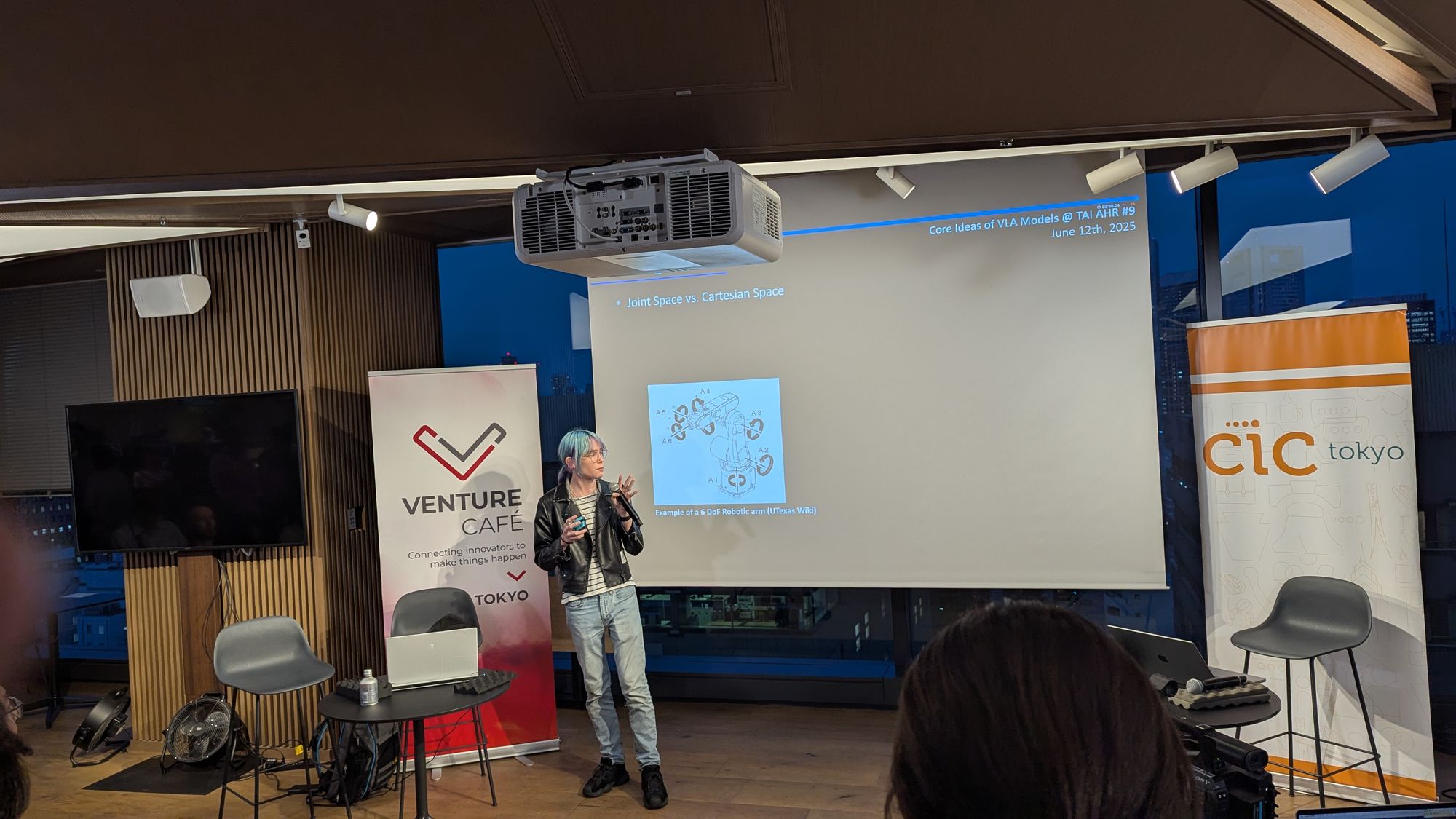
Maxime Alvarez, Robotics AI Engineer at Telexistence, emphasizes that the environment changes during inference. His talk examines several approaches: generating actions faster, producing a sequence of actions at once, running inference in parallel with execution, and separating slower understanding from faster action generation.
Action chunking produces multiple future actions together. It can reduce how often the full model must run, but the system then needs to decide how much of that sequence to execute before incorporating a new observation. Waiting longer may reduce computation while allowing the world to diverge from the state the model saw.
Asynchronous inference offers another arrangement: execute part of the previous action sequence while computing the next one. The SmolVLA research, referenced in Alvarez’s talk, provides one example of this direction.
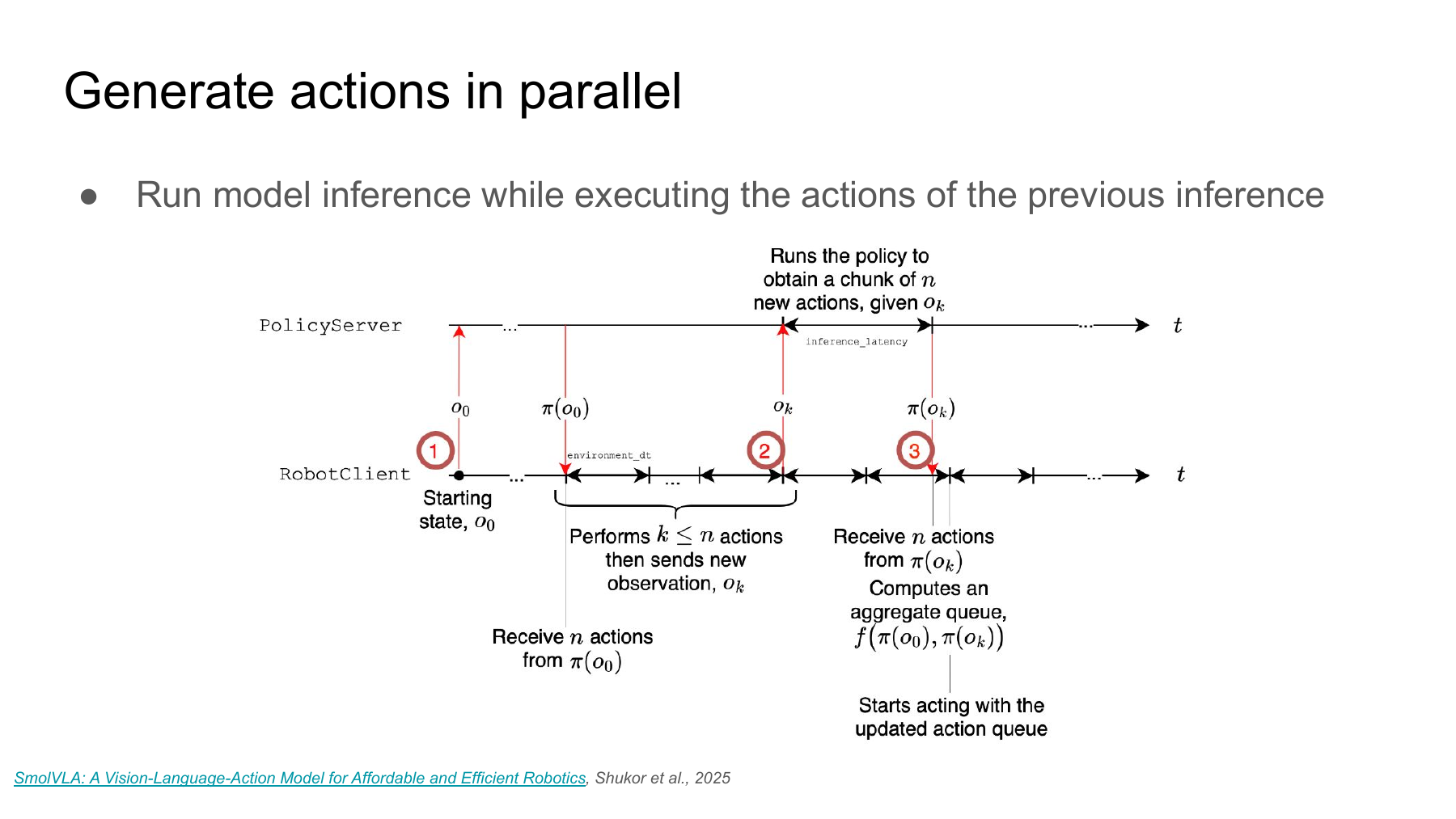
The engineering question is what happens where the sequences meet. A new prediction may not begin smoothly from the state the robot has actually reached. Alvarez explicitly identifies continuity and the handling of overlapping predictions as concerns. Higher model throughput alone does not resolve them.
A larger model is not the whole control system
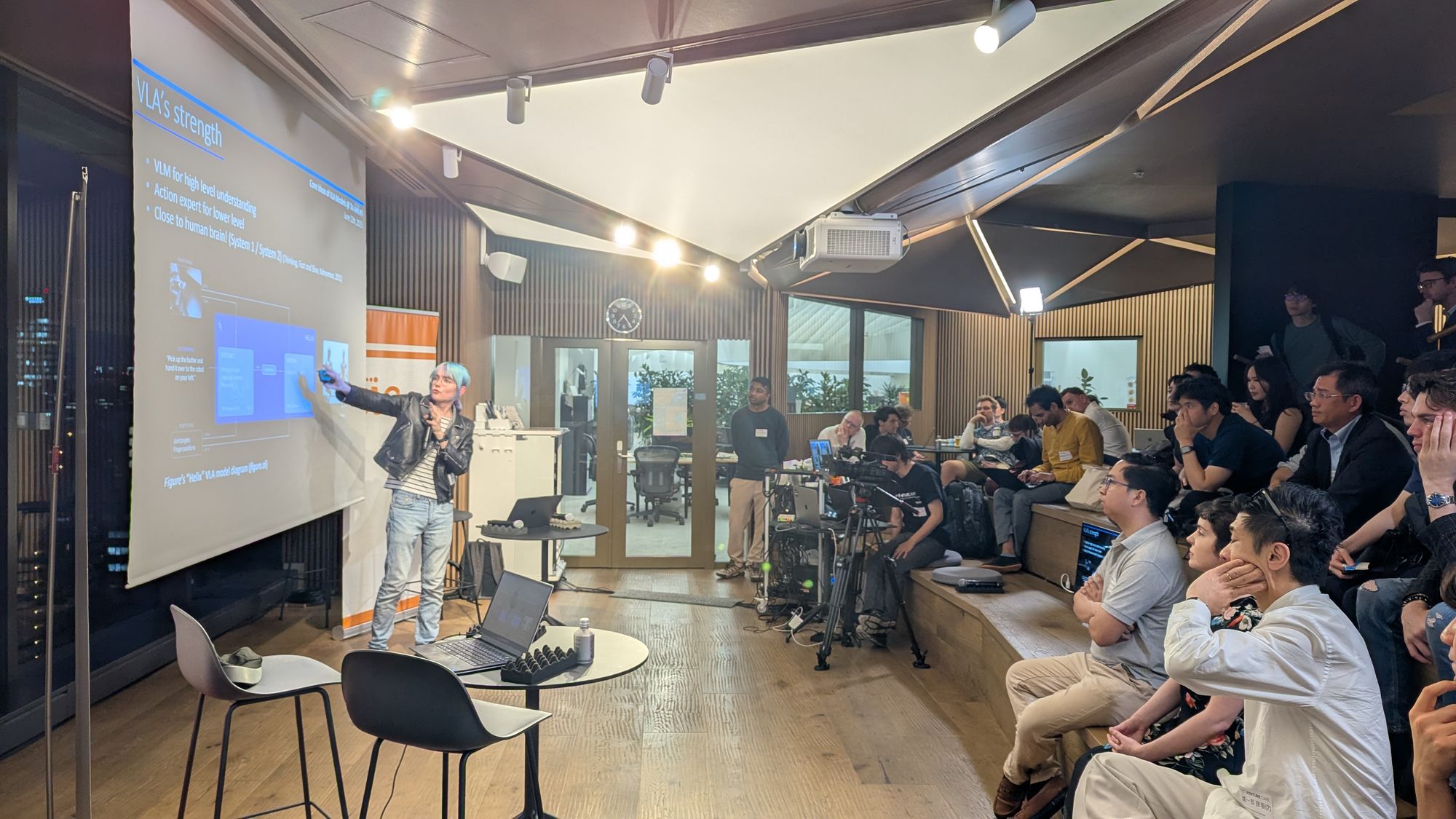
Alvarez also discusses dual-system designs, with a slower component responsible for broader understanding and a faster component producing actions. The communication between those parts becomes an architectural problem of its own.
A task-level instruction needs enough precision to guide the faster system, while feedback needs to reveal when the instruction no longer fits the situation. The boundary should make it possible to stop or revise a plan without losing track of what the robot is doing.
Ibrahim Orhan’s announced talk extends the motivation to mobile robots operating outside tightly controlled settings. That broader ambition makes the deployment conditions more important, not less: general-purpose capability still has to enter a specific environment with specific responsibilities.
Foundry’s perspective: evaluate stale observations, not only successful grasps
Consider an illustrative robot that sorts objects on a work surface. A PoC can show that a model selects sensible actions from camera images. A deployment review should also ask how old an observation is when the corresponding action begins, and what happens if the scene changes during that interval.
We would test the complete perception-to-action path in a controlled setting, including sensing, preprocessing, inference, action buffering, and execution. A delay in any stage can change behavior even when the model itself is unchanged. Tests should examine smooth transitions, interruptions, and recovery, with limits set by the robotics team for the actual hardware.
The first operating scope can be narrow: a defined object set and work area, with a clear route to intervention. Changes in lighting, object arrangement, or task frequency then become deliberate evaluation cases. The point is to understand where the behavior remains useful and where the system must hand control back.
The business measure is completed work under those conditions, including the cost of intervention and recovery. A model that looks strong on isolated predictions may create a poor workflow if it frequently needs help at transitions.
That is the connection to Foundry Labs’ robotics and edge AI engineering. A VLA becomes a deployed capability when its timing, interfaces, and operating boundaries are evaluated as one system.
Sources and further reading
This article draws on the TAI AHR #09 - Foundation Models for Robotics programme and the talks identified above. Tokyo AI (TAI) connects researchers, engineers, and industry; explore Foundry Labs’ community work for more context.
Talk materials from Émilie Fabre and Maxime Alvarez are available upon request. Please use our contact form and include the event title and speaker name.
Speaker profiles
Émilie Fabre. Research Assistant and PhD candidate at the University of Tokyo, working on XR and robotics. LinkedIn.
Maxime Alvarez. Robotics AI Engineer at Telexistence and PhD student at the University of Tokyo. LinkedIn.
Ibrahim Orhan. Co-founder and CEO of Kanaria Tech, developing mobile robotics systems. LinkedIn.
All articles